


























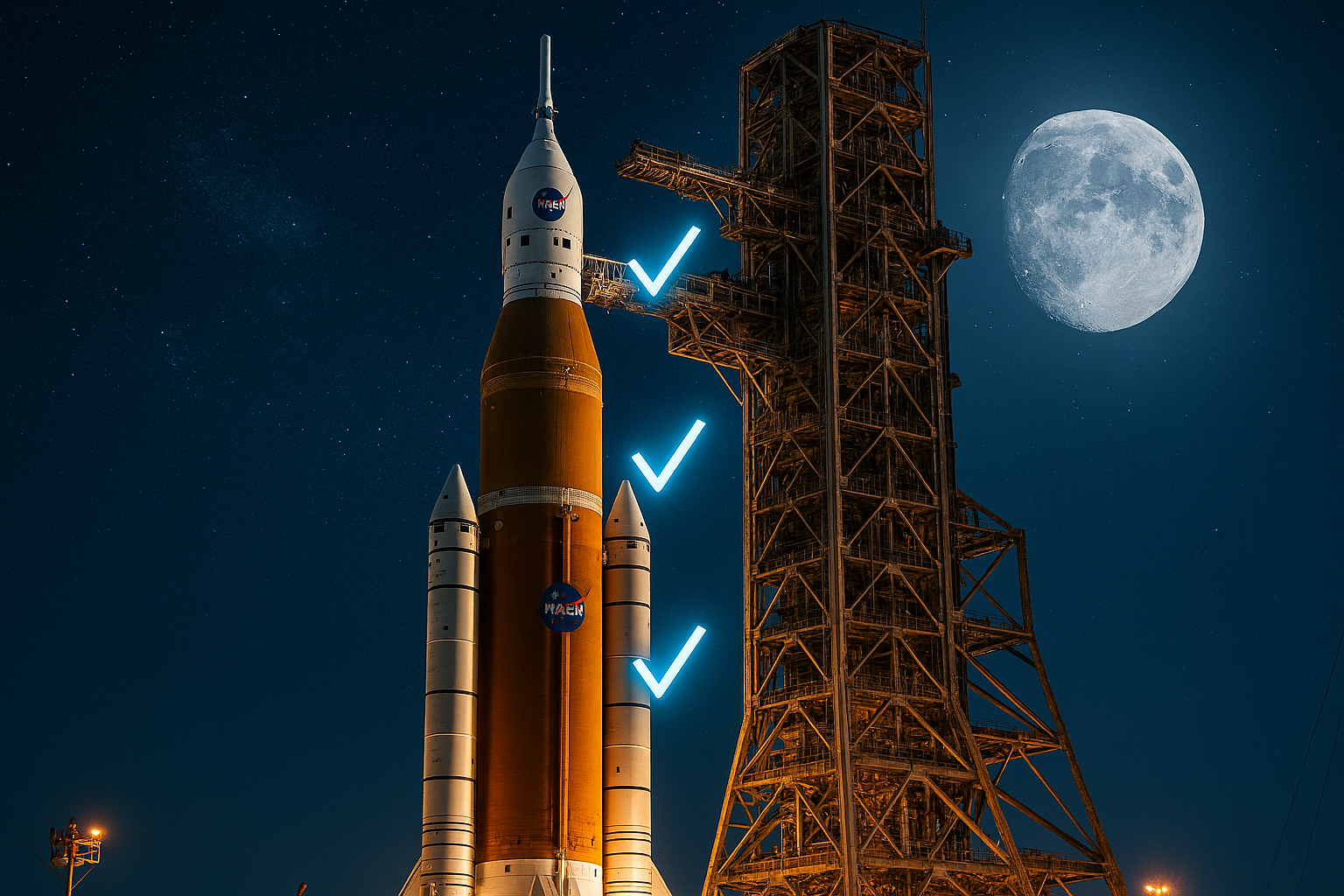
Artemis II flight readiness has reached its final critical checks ahead of the historic crewed Moon loop mission. NASA reports that engineers have completed Orion spacecraft stacking and are now conducting comprehensive power, communications, and life-support tests. Meanwhile, the Space Launch System core stage and boosters undergo final alignment at Kennedy Space Center, with crew members Reid Wiseman, Victor Glover, Christina Koch, and Jeremy Hansen finishing intense integrated simulations covering the full 10-day mission profile.
NASA says Artemis II is on track for its loop around the Moon, and a fresh flight readiness update highlights how the mission’s hardware and crew training are coming together for a launch window later this year.
Flight readiness milestones in focus
- Orion gets its final health checks. Engineers finished stacking the crew module and European service module, and are now running end-to-end power, comms, and life-support tests.
- Space Launch System work shifts to fine tuning. Core stage avionics and booster segments are in final alignment at Kennedy, with simulated countdowns validating software redundancy.
- The crew is rehearsing every minute. Reid Wiseman, Victor Glover, Christina Koch, and Jeremy Hansen completed integrated sims covering trans-lunar injection through splashdown to stress-test decision making.
Why this update matters
Artemis II is the first crewed deep-space mission in more than 50 years, and NASA’s cadence of readiness reviews shows the program is learning from Artemis I while keeping safety margins wide. The agency is also signaling to commercial partners, lunar science teams, and international contributors that the broader Artemis timeline is holding.
What happens next
NASA will host a briefing this week to walk through the outstanding action items—mainly additional heat-shield inspections, RS-25 engine recertifications, and range coordination. If those stay green, the agency will pin its formal launch date for the 10-day mission that will send the crew 10,000 kilometers beyond the far side of the Moon before returning to Earth.
Source: The Daily Galaxy / NASA