


























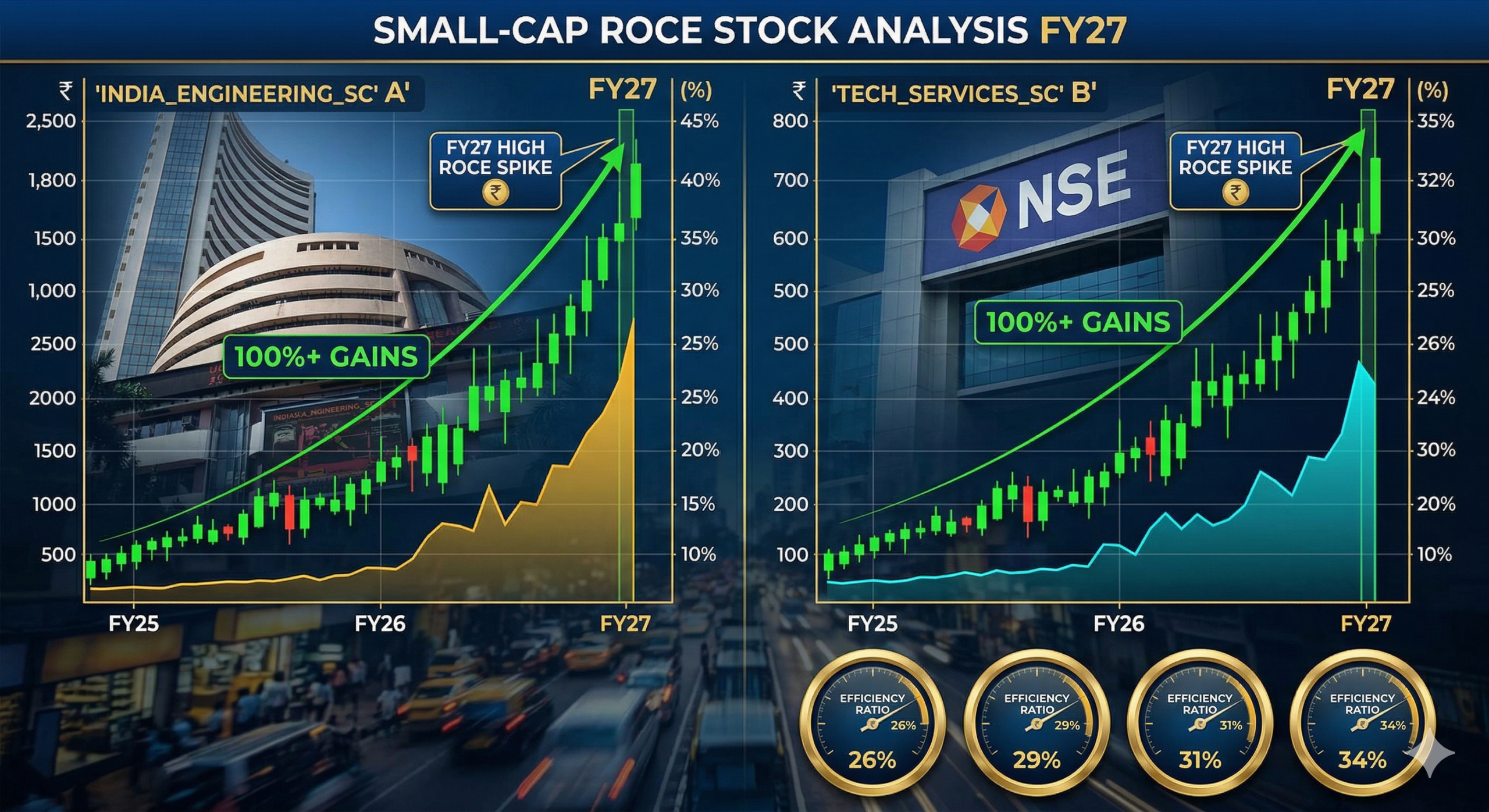
Small-cap ROCE stocks FY27 are capturing smart money attention as Indian markets transition from liquidity-driven speculation to fundamental quality. These two standout performers delivered over 100% returns in the past year while maintaining exceptional Return on Capital Employed (ROCE), proving management allocates capital with superior efficiency. Investors prioritizing ROCE alongside price momentum gain early exposure to sustainable compounders before broader market recognition.
Estimated reading time: 5 minutes
- Small-cap stocks show potential for high returns.
- The market is shifting focus from speculation to fundamentals.
- Return on Capital Employed (ROCE) is crucial for evaluating small-cap performance.
- Investors must focus on quality and sustainability as FY27 unfolds.
- Thorough research is essential to navigate the evolving market landscape.
- The Shift from Liquidity to Fundamentals
- Why ROCE and Momentum Matter
- What Investors Should Watch in FY27
- Final Thoughts: Quality Over Speculation
The Shift from Liquidity to Fundamentals
As the financial calendar turns to FY27, the Indian stock market is witnessing a notable shift in investor sentiment. While the small-cap segment has historically been viewed as a high-risk playground, often compared to a high-stakes casino, the landscape is evolving. Smart money is moving away from speculative bets and focusing on quality growth backed by strong fundamentals. Recent market analysis has highlighted two specific small-cap stocks that are entering this new financial year with significant momentum, boasting over 100% returns in the last year alone.
Why ROCE and Momentum Matter
For years, easy liquidity in the market allowed even weaker companies to see their stock prices inflate. However, as that liquidity hangover fades, the market is forcing a return to basics. Investors are no longer satisfied with mere price movement; they are demanding efficiency and profitability.
The recent focus on Return on Capital Employed (ROCE) signals that investors are looking for businesses that generate high returns from every rupee invested in the company. This fundamental shift is separating the temporary winners from the long-term wealth creators.
What Investors Should Watch in FY27
The two small-cap stocks identified in recent reports stand out not just because of their price appreciation, but because of how they achieved it. Delivering over 100% returns in a single year is impressive, but maintaining an exceptional ROCE alongside that growth is what validates the performance.
ROCE is a key profitability ratio that measures how efficiently a company uses its capital. A high ROCE indicates that management is deploying resources effectively to generate profits. When combined with positive price momentum, it suggests that the market is recognizing this efficiency and rewarding the stock accordingly.
As FY27 unfolds, the momentum behind these high-efficiency stocks may continue, but caution is still advised. The small-cap segment remains sensitive to macroeconomic changes and global liquidity conditions. Investors looking to capitalize on this trend should pay attention to quarterly earnings reports to ensure that the high ROCE is sustainable and not a one-time anomaly.
Final Thoughts: Quality Over Speculation
The identification of these two small-cap stocks underscores a broader theme for FY27: quality is king. The era of buying any small-cap stock and hoping for a rally is likely over. Instead, the focus is on companies with proven track records of capital efficiency and strong market momentum.
For retail investors, this serves as a reminder to dig deeper into financial statements before chasing returns. While the potential for wealth creation in the small-cap space remains intact, the path forward favors those who prioritize fundamentals over fads. As always, thorough research and a long-term perspective are the best tools for navigating the opportunities ahead in FY27.
Frequently Asked Questions (FAQ)
1. What should investors look for in small-cap stocks?
Investors should focus on companies with high Return on Capital Employed (ROCE) and sustainable growth prospects to ensure better investment outcomes.
2. Why is ROCE important?
ROCE helps in evaluating how effectively a company utilizes its capital to generate profits, making it a vital measure for assessing investment quality.
3. How can market liquidity affect small-cap stocks?
Changes in market liquidity can shift investor sentiment and impact stock prices, making it crucial for investors to evaluate small caps against fundamental performance as liquidity conditions evolve.