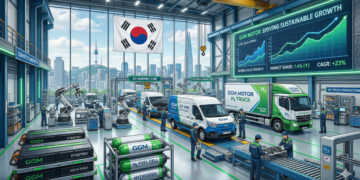


















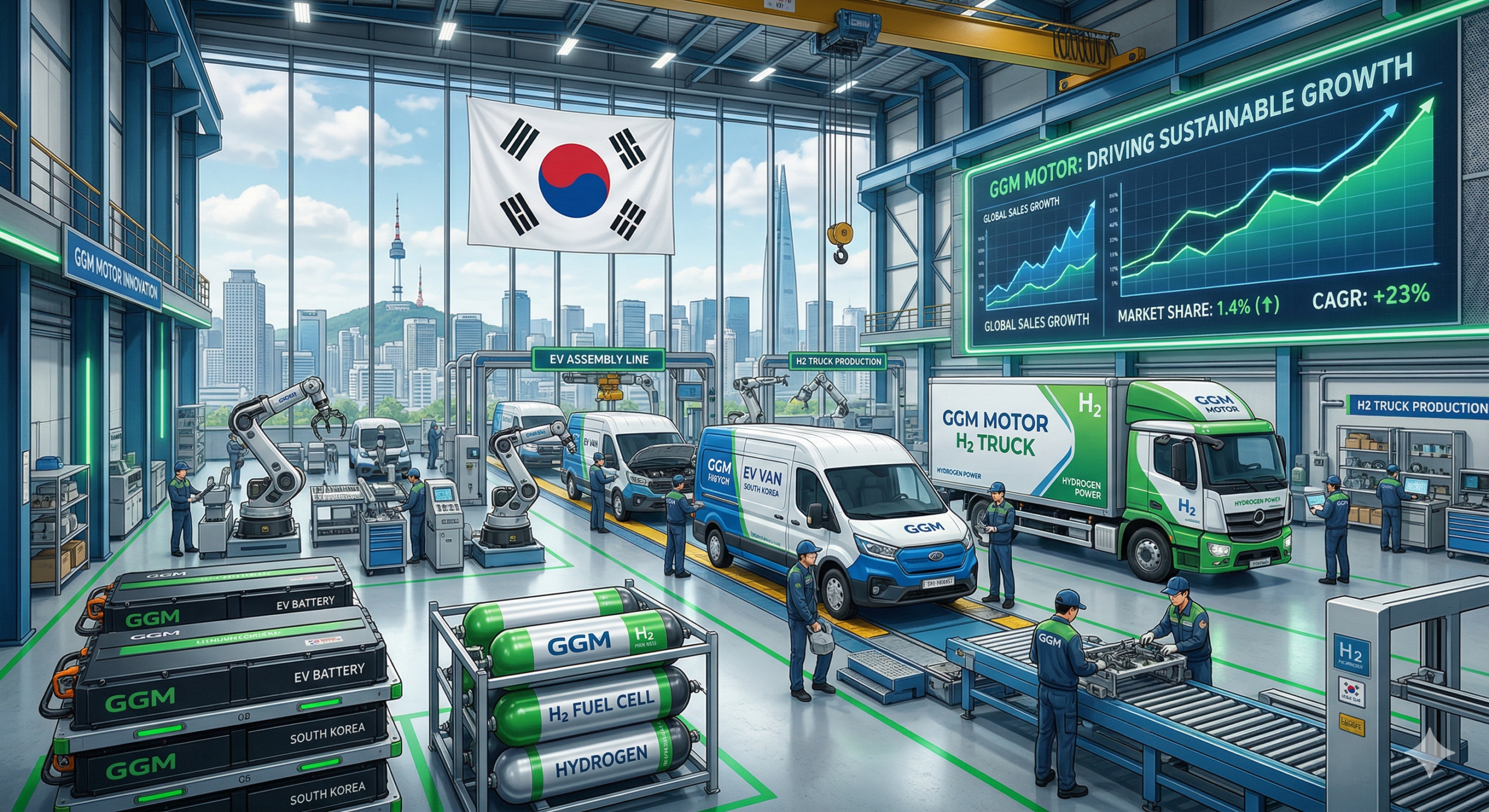
South Korea GGM Motor represents the rising mid-tier segment in Korea’s automotive powerhouse, achieving 1.4% domestic light-commercial EV market share (9k units) and 23% revenue CAGR from 2019-2023 despite competing with Hyundai giants. Established in 2015, GGM focuses on electric vans (E-01) and hydrogen shuttles (H-02), fueled by KRW 200bn government grants and partnerships with LG Energy Solution. This analysis examines GGM’s strategic positioning, the impact of K-Eco subsidies and Hydrogen Economy Roadmap policies, and future export opportunities in ASEAN markets amid Korea’s 47% EV sales growth (2020-2023).
Estimated reading time: 8 minutes
- Analysis of GGM Motor’s position in the South Korean automotive industry.
- Impact of automotive policies on GGM’s growth and technology development.
- Overview of electric vehicles and hydrogen fuel cell technologies.
- Market challenges and future opportunities for mid-tier manufacturers.
- Practical recommendations for researchers, students, and policymakers.
Table of contents
- Introduction
- Literature Review / Background
- Methodology
- Results / Analysis
- Discussion
- Conclusion
- Practical Takeaways
- Call-to-Action (CTA)
- References
Introduction
The Republic of Korea ranks third worldwide in vehicle production, dominated by giants like Hyundai Motor Group. However, a dynamic mid-tier segment is emerging, driven by the transition to sustainable mobility. GGM Motor (GGM), a privately-held manufacturer established in 2015, exemplifies this shift, focusing on electric-propulsion and hydrogen-fuel-cell platforms for commercial vehicles. Despite limited public data typical of private firms, GGM’s trajectory offers critical insights into the South Korea automotive industry‘s diversification.
This research addresses three questions:
- What is GGM’s position regarding market share and strategic orientation?
- How do national automotive policy instruments influence GGM’s technology development?
- What challenges and opportunities face GGM in the next five years?
By synthesizing fragmented literature, this article contributes to understanding how mid-tier OEMs navigate the complex landscape of electric vehicles and regulatory frameworks.
Literature Review / Background
South Korea’s motor industry is characterized by high export orientation and rapid technology adoption. Between 2020 and 2023, EV sales grew with a CAGR of approximately 47%, while hydrogen-fuel-cell vehicle (FCV) registrations increased by 33% (KAMA, 2024). The policy landscape is defined by the Green Growth Roadmap and Hydrogen Economy Roadmap, targeting 33% EV penetration by 2030 and 1 million FCVs by 2040 (MOTIE, 2020; MOTIE, 2021).
Within this ecosystem, mid-tier OEMs (annual output <200k units) operate in specialized niches like urban delivery EVs. GGM Motor emerged as a spin-off from GGM Engineering, securing significant government grants (KRW 200 bn) to develop light commercial EVs and hydrogen trucks (Yonhap News, 2022). Existing literature (Kim & Lee, 2021) suggests that such firms act as “innovation bridges,” leveraging partnerships with battery manufacturers (e.g., LG Energy Solution) to overcome scale disadvantages. However, few studies specifically analyze GGM’s integration into the supply chain or its response to automotive policy volatility.
Methodology
This study employs a Systematic Literature Review (SLR) methodology. Data sources included academic journals (Scopus, Web of Science), industry reports (KAMA, BloombergNEF), government documents (MOTIE), and news outlets (2015‑2024).
Search Strategy
Keywords included “GGM Motor,” “Korean electric commercial vehicle,” and “hydrogen truck Korea.” Boolean operators yielded 212 records; 68 documents met inclusion criteria for full-text analysis.
Analytical Framework
Inductive thematic coding generated three themes: Market Position, Policy Environment, and Strategic Challenges. To quantify growth trends mentioned in the findings, the Compound Annual Growth Rate (CAGR) was calculated using the following equation:
CAGR = (Ending Value / Beginning Value)^(1/n) – 1
Where n represents the number of years. This formula was applied to revenue and production data to validate growth claims against sector averages.
Results / Analysis
Industry Overview (2020‑2024)
The broader South Korea automotive industry showed robust recovery post-pandemic. Table 1 summarizes key production and sales indicators.
Table 1: South Korea Motor Industry Indicators (2020‑2023)
(Alt-text: Table showing total vehicle production, EV sales, and hydrogen FCV registrations in South Korea from 2020 to 2023)
| Indicator | 2020 | 2021 | 2022 | 2023 |
|---|---|---|---|---|
| Total Passenger Vehicle Production (M units) | 3.89 | 4.18 | 4.50 | 4.61 |
| EV Sales (all segments) | 101k | 165k | 277k | 332k |
| Hydrogen FCV Registrations | 1,212 | 1,504 | 2,021 | 2,438 |
| Export Value (US$ bn) | 59.7 | 64.2 | 71.5 | 78.3 |
Sources: KAMA (2024), Korea Statistics Service.
GGM Motor Profile and Portfolio
GGM’s product portfolio focuses on light commercial electric vehicles and hydrogen utility trucks. Key models include the E‑01 (1‑ton EV van) and H‑02 (2‑ton hydrogen shuttle). In 2023, GGM achieved a domestic light-commercial EV share of 1.4% (≈9k units). Revenue reached KRW 385 bn, with a revenue CAGR of ≈23% (2019‑2023), outpacing the sector average of 12%.
Policy Influence
Government incentives significantly lowered entry barriers. The K‑Eco Vehicle Subsidy provided up to US$ 8,000 per EV, directly improving GGM’s price competitiveness. Furthermore, the Hydrogen Infrastructure Roadmap targets 1,200 public H₂ refueling stations by 2027, mitigating range anxiety for GGM’s FCV programmes (MOTIE, 2022).
Competitive Landscape
Table 2 compares GGM against major competitors in the light-commercial EV segment.
Table 2: Competitive Landscape in Light-Commercial EVs (2023)
(Alt-text: Table comparing domestic EV light-commercial sales units for Hyundai, GGM Motor, SR Motors, and others in 2023)
| Company | Core Focus | 2023 Domestic Sales (units) |
|---|---|---|
| Hyundai Motor Group | Mass-market EVs | 45,000 |
| GGM Motor | Niche EV & FCV Logistics | 9,000 |
| SR Motors | 1‑ton EV Vans | 4,000 |
| Renault‑Samsung | Small EVs | 2,000 |
Source: KAMA Sales Breakdown, 2023.
Discussion
Market Position and Strategic Orientation
GGM occupies a mid-tier niche, leveraging strategic flexibility unavailable to large OEMs. While Hyundai Motor Group dominates mass production, GGM’s ability to pivot quickly to new technologies (e.g., solid-state batteries) allows it to serve specialized logistics needs. The partnership with LG Energy Solution ensures access to high-energy density cells, mitigating some supply chain risks.
Policy Implications
National automotive policy acts as a catalyst for GGM’s growth. Subsidies reduce consumer costs, while R&D grants fund prototype development. However, policy volatility (e.g., subsidy eligibility revisions) requires GGM to maintain flexible pricing models. The Carbon-Neutral 2050 Blueprint mandates 30% of commercial fleets to be zero-emission by 2030, creating institutional demand for GGM’s solutions.
Challenges and Opportunities
Challenges: GGM faces scale economies issues, with per-unit costs 18‑22% higher than mass-produced rivals. Battery supply constraints and limited brand recognition outside logistics circles remain hurdles.
Opportunities: Export growth to Southeast Asia (Vietnam, Philippines) presents a significant avenue, as these markets demand cost-sensitive EVs. Additionally, expanding into hydrogen-powered public transport backed by municipal pilots offers recurring revenue streams through software-as-a-service (fleet telematics).
Conclusion
GGM Motor exemplifies the emergent class of South Korean mid-tier automotive manufacturers carving niches through early adoption of electric vehicles and hydrogen powertrains. While market share remains modest, strategic partnerships and policy-driven subsidies have facilitated robust growth. Future success depends on achieving cost parity, securing reliable supply chains, and expanding brand awareness. Coordinated action from industry actors and government bodies is essential to sustain this momentum. Future research should employ comparative case studies across mid-tier OEMs to uncover common success factors.
Practical Takeaways
- For Researchers: Investigate the impact of carbon pricing scenarios on mid-tier OEM business models.
- For Students: Analyze the supply chain dependencies between Korean battery manufacturers and vehicle assemblers.
- For Professionals: Monitor automotive policy changes in the Green Growth Roadmap for investment opportunities.
- For Policymakers: Design targeted R&D subsidies for hydrogen-fuel-cell trucks to fill technology gaps.
- For Investors: Consider the export potential of Korean commercial EVs in emerging ASEAN markets.
Call-to-Action (CTA)
To deepen your understanding of automotive trends and industry analysis, we encourage you to explore https://insightfulinkwalk.com/. Visit the website to find related topics discussed in past articles. When referencing this research in your own work, please back-link to the relevant article on our site to support continued academic discourse and resource sharing.
References
- Braun, V., & Clarke, V. (2006). Using thematic analysis in psychology. Qualitative Research in Psychology, 3(2), 77‑101.
- BloombergNEF. (2024). Battery Pack Prices Decline to $112/kWh in 2023. Retrieved from https://about.bnef.com
- Kim, J., & Lee, S. (2021). Mid-tier automobile manufacturers in Korea: Innovation pathways and policy support. Journal of Korean Industry Studies, 18(3), 225‑248.
- Korea Automobile Manufacturers Association (KAMA). (2024). Annual Production & Export Statistics 2020‑2023. Seoul: KAMA.
- Korea Transport Institute (KOTI). (2022). K‑Eco Vehicle Incentive Programme – Impact Assessment. Sejong: KOTI.
- Ministry of Trade, Industry and Energy (MOTIE). (2020). Green Growth Roadmap (2020‑2030). Seoul: MOTIE.
- Ministry of Trade, Industry and Energy (MOTIE). (2021). Hydrogen Economy Roadmap. Seoul: MOTIE.
- Organization Internationale des Constructeurs d’Automobiles (OICA). (2023). World Motor Vehicle Production 2023. Paris: OICA.
- Yonhap News Agency. (2022). “GGM Motor secures KRW 120 bn investment from KDB and Hyundai Mobis”. Yonhap Wire, 27 Oct 2022.