























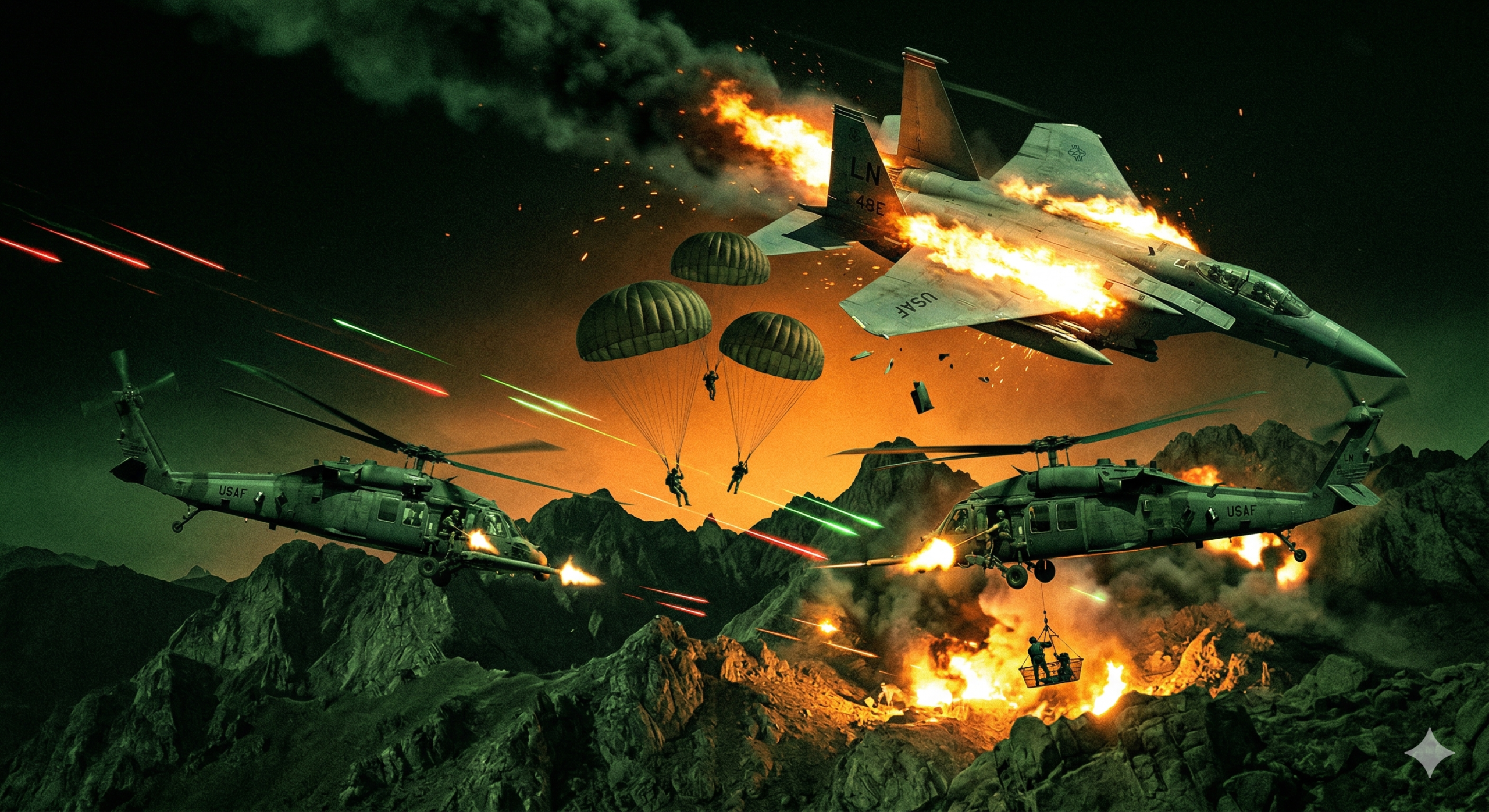
The US F-15E Strike Eagle shootdown exposed the high risks of modern air combat when a Strike Eagle was lost to enemy fire, launching one of the most intense combat search and rescue missions in recent military history. This incident highlights the tactical vulnerabilities of the F-15E platform, the crew’s survival training, and the coordinated precision required to extract pilots from hostile territory under fire.
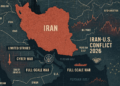
In the modern theater of warfare, the margin between a successful mission and a catastrophic loss is measured in split seconds and fractions of a degree. This harsh reality is vividly illustrated in a complex, hypothetical combat scenario set in the rugged terrain of the Zagros Mountains on April 3, 2026. This detailed analysis breaks down a multi-layered military operation involving the downing of a US F-15E Strike Eagle, the heroic efforts of a combat search and rescue (CSAR) team, and the technological chess match between fifth-generation stealth fighters and advanced air defense networks.
By examining this highly realistic simulation, we gain profound insights into modern air combat tactics, the vulnerabilities of cutting-edge technology, and the unwavering commitment to the military ethos that no one gets left behind.
The Mission Begins: The US F-15E Strike Eagle Enters Hostile Airspace
The operation commences in the dead of night at 02:15 hours. A flight of two aircraft, led by a highly capable US F-15E Strike Eagle, crosses into Iranian airspace at an incredibly low altitude. The US F-15E Strike Eagle is renowned for its dual-role capabilities, functioning as an elite air-to-air fighter and a devastatingly effective deep-strike bomber. On this particular night, the US F-15E Strike Eagle is acting as the ultimate “bomb truck,” tasked with a high-stakes mission: neutralizing a deeply buried command bunker.
To survive in heavily contested airspace, the crew of the US F-15E Strike Eagle relies heavily on terrain-following radar. The Zagros Mountains, characterized by jagged peaks and deep, narrow valleys, present a tactical nightmare for aviators. However, this same treacherous terrain provides excellent “terrain masking.” By flying deep within the valleys, the US F-15E Strike Eagle stays beneath the radar horizon, effectively hiding from Iran’s long-range Bavar-373 missile network.
The Critical Vulnerability: Breaking the Radar Horizon
The flaw in terrain masking is that it cannot last forever. To deploy its payload—specifically the massive GBU-28 “bunker buster” bomb—the US F-15E Strike Eagle must execute a pop-up maneuver.
As the lead US F-15E Strike Eagle pulls up above the mountain peaks to designate its target, it breaks the radar horizon. In a gorge below, a highly mobile surface-to-air missile (SAM) system is lying in wait. The trap is sprung. The SAM system quickly achieves a radar lock on the exposed US F-15E Strike Eagle and fires two missiles.
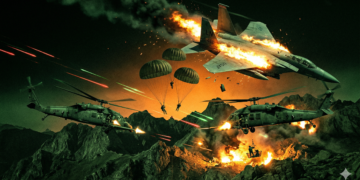
The pilot of the US F-15E Strike Eagle immediately reacts, dumping flares and pulling high-G evasive maneuvers. While the first missile is successfully spoofed, the second detonates in close proximity. The resulting shockwave and shrapnel cause catastrophic hydraulic failure, crippling the aircraft. With no other options, the crew of the US F-15E Strike Eagle ejects into the pitch-black, freezing mountains of the Kohgiluyeh and Boyer-Ahmad province. Instantly, the military’s “Sandy” protocol—the elite combat search and rescue operation—is activated.
The A-10 Warthog: A High-Risk Rescue Escort
Because the crash site of the US F-15E Strike Eagle is near the border, military commanders divert an A-10 Thunderbolt II (affectionately known as the “Warthog”) operating nearby to serve as a Rescue Escort (RESCORT). Down in the valleys, Iranian quick-reaction forces are already closing in on the downed crew of the US F-15E Strike Eagle.
The A-10 executes a blistering low-level strafing run, utilizing its legendary 30mm Avenger Gatling cannon to neutralize the approaching enemy convoy. However, this aggressive maneuver comes with a massive cost.
- The Threat of MANPADS: The noise and bright tracers from the A-10’s cannon give away its position.
- The Hit: As the A-10 banks hard, bleeding off airspeed, an Iranian soldier fires a Chinese-made MSAD-2 infrared-guided shoulder-fired missile (MANPADS).
- The Damage: At such a low altitude, the A-10’s countermeasures deploy too late. The missile shreds the right turbofan engine.
Remarkably, the A-10’s legendary armor—including its titanium “bathtub” that protects the pilot—saves the aircraft from immediate destruction. The pilot nurses the dying jet away from the hostile mountains and toward safer airspace, eventually ejecting safely over the southern waters of the Persian Gulf near the Strait of Hormuz.
The Combat Search and Rescue (CSAR) Mission Launches
By 03:15 hours, a dedicated CSAR package launches to recover the stranded aviators. These highly trained rescue units are built explicitly for the chaotic aftermath of losing an aircraft like the US F-15E Strike Eagle. The package includes:
- An HC-130J Combat King acting as an airborne command center.
- Two H-60 Pave Hawk helicopters, call signs Pedro 11 and Pedro 12.
Flying nap-of-the-earth to remain undetected, the helicopters top off their fuel in midair to maximize their loiter time. By 04:45 hours, Pedro 11 locates the infrared strobe of the downed A-10 pilot.
As Pedro 11 flares for landing, disaster strikes again. A hidden Soviet-era ZU-23 anti-aircraft gun opens fire from a concealed hideout. It is a perfectly executed ambush. Heavy armor-piercing rounds tear through Pedro 12 as it provides overwatch, severing transmission lines and injuring the crew. The pilot wrestles the crippled chopper into a hard, controlled crash near Pedro 11.
Stealth Over-Watch: F-35 Fighters Turn the Tide
The rescue mission for the personnel linked to the US F-15E Strike Eagle and A-10 incidents has now devolved into a desperate fight for survival. Pedro 11 is the only way home.
Under heavy covering fire, the downed crew of Pedro 12 sprints to the surviving bird. Overhead, the C-130 coordinates an immediate, devastating strike. Two F-35 stealth fighter jets, loitering high above in stealth overwatch, drop precision munitions that instantly silence the ZU-23 anti-aircraft gun.
Crammed with the A-10 pilot, the Pararescue Jumpers (PJs), and the crashed chopper’s crew, Pedro 11 is severely overloaded. Pulling maximum power with its engines screaming, the helicopter barely clears the tree line. By diving back into the valleys and racing for the border, Pedro 11 crosses into Iraqi airspace by 05:30 hours. They are battered and overloaded, but alive. However, the sobering reality remains: the original crew of the US F-15E Strike Eagle is still missing in action, necessitating an even larger Joint Special Operations raid the following night.
Analyzing F-35 Vulnerabilities: Stealth vs. Heat-Seeking Missiles
While the focus of the night was the downed US F-15E Strike Eagle, the scenario also highlights critical vulnerabilities of fifth-generation aircraft like the F-35. The F-35 is designed to be practically invisible to long-range, radio-frequency radar systems. Its geometry and radar-absorbent materials make its radar cross-section incredibly small—comparable to a bird.
However, stealth does not mean completely invisible. Modern air defense networks utilize advanced Infrared Search and Track (IRST) systems to bypass radar completely.
- The Engine Heat Plume: The F-35 is powered by a massive, single Pratt & Whitney F135 engine. This engine produces a massive heat plume that passive infrared sensors can detect without emitting any warning signals to the pilot.
- The 358 Missile Threat: Iran utilizes the “358” anti-aircraft missile (or SA67), a unique hybrid between a loitering munition and a surface-to-air missile. It flies at subsonic speeds in a figure-eight pattern, waiting for its optical and infrared sensors to detect the intense heat signature of a passing jet.
When an infrared-guided missile locks onto an F-35, the jet relies on its Distributed Aperture System (DAS)—six infrared cameras providing a 360-degree spherical view. The DAS detects the incoming missile’s rocket motor and alerts the pilot to break the lock using high-G maneuvers and ultra-hot magnesium flares. If the missile’s proximity fuse triggers near the jet, the resulting shrapnel can cause significant damage to the stealth coating and internal systems without necessarily destroying the aircraft.
Why the US F-15E Strike Eagle Remains the Premier “Bomb Truck”
Despite the existence of stealth fighters, the US F-15E Strike Eagle remains a critical component of the United States Air Force’s arsenal. Why rely on a non-stealthy US F-15E Strike Eagle in highly contested airspace? The answer lies in payload capacity and mission endurance.
While F-35s and B-2 bombers act as the “door kickers” to suppress air defenses and hit deeply buried targets, the US F-15E Strike Eagle hunts mobile targets. Each US F-15E Strike Eagle can be heavily laden with up to 19 Joint Direct Attack Munitions (JDAMs) or 28 Small Diameter Bombs. Working in tandem, pairs of US F-15E Strike Eagle aircraft use their advanced AESA radars to scan the ground for hiding ballistic missile launchers, convoys, and secondary command nodes. Once a US F-15E Strike Eagle is “Winchester” (out of ammo), it can retreat to aerial tanker tracks, refuel in midair, and return for a second sortie.
Time on Target: Dismantling an Air Defense Network
The hypothetical scenario concludes by answering a vital question: how do aircraft like the US F-15E Strike Eagle and F-35 operate over a country with a robust air defense network in the first place? The answer is total systemic shock and electronic warfare.
To cripple Iranian defenses, military planners rely on a tactic called “Time on Target.” This mathematical choreography ensures that weapons fired from vastly different locations impact their targets at the exact same second.
- Cruise missiles launch from submarines and escort ships.
- Massive payload drops occur from stealth bombers.
- Fighter jets release guided bombs.
This coordinated strike is designed to induce systemic shock and collapse the enemy’s operational capabilities instantly.
Simultaneously, the US military utilizes a highly advanced mix of electronic warfare. The coalition injects false data directly into Iranian radar screens, completely overwhelming Russian-supplied and homegrown defense batteries. To hunt the remaining SAM sites down, forces launch hundreds of ADM-160 MALD (Miniature Air-Launched Decoy) drones. To a panicked radar operator, these tiny drones look exactly like a massive incoming squadron of US F-15E Strike Eagle and F-16 fighters. With the air defenses distracted and depleted, fifth-generation stealth fighters slice through the airspace undetected, dismantling the network entirely.
Conclusion
The simulated loss of a US F-15E Strike Eagle over the Zagros Mountains serves as a powerful case study of the chaotic, high-stakes nature of modern combat. It highlights that no matter how advanced the technology becomes—from stealth coatings to infrared countermeasures—the human element remains paramount. The incredible risks taken by A-10 pilots and helicopter crews to rescue a downed US F-15E Strike Eagle crew underscore the unwavering military commitment to leaving no one behind. As adversaries continually adapt and upgrade their defenses, aircraft like the US F-15E Strike Eagle will continue to evolve their tactics, relying on complex electronic warfare, perfectly timed strikes, and sheer technological dominance to survive the skies of tomorrow.