






















Introduction
In 2025, ABI Research reported that 50,000 warehouses will use robots with over 4 million commercial units installed—a massive jump from just 4,000 robotic warehouses in 2018 (ABI Research, 2024). Yet narrow aisles remain a critical barrier. Traditional autonomous mobile robots (AMRs) need 10-12 foot aisles, and even very narrow aisle (VNA) systems require 5.5-6 feet.
An omnidirectional asymmetric mobile robot changes the game. By placing wheels asymmetrically, researchers at IIT Bombay cut robot width in half—down to just 77mm—while maintaining full holonomic movement. This design eliminates turning radius requirements entirely.
This article breaks down the technical innovations behind asymmetric omnidirectional robots, explains the kinematic equations that enable precise control, and shows real experimental performance data from the IEEE ICC 2024 research paper.
Key Takeaways
- Asymmetric wheel placement reduces robot width to 77mm versus 150mm+ for conventional designs (IIT Bombay, 2024)
- Omnidirectional movement eliminates turning radius, enabling operation in aisles as narrow as 1.1 meters
- Prototype achieved mean deviation under 6.23cm across 2.46m test distances with PID control
Why Do Narrow Aisles Matter for Warehouse Efficiency in 2026?
In 2025, warehouse space utilization improved 30-50% with AMR systems, while high-density storage configurations increased storage density by 300-500% (OPLOG, 2025). This dramatic improvement stems from one simple fact: every foot of aisle width eliminated translates directly into more storage positions.
Traditional warehouses allocate roughly 50% of floor space to aisles alone. Standard forklifts need 10-12 foot aisles to turn and maneuver. VNA (very narrow aisle) trucks reduce this to 5.5-6 feet but still require significant turning space at aisle ends.
Omnidirectional robots change this equation fundamentally. Because they move in any direction without turning, aisles can shrink to match the load dimensions plus minimal clearance. Commercial systems now operate in aisles as narrow as 1.1 meters (Reeman MINI) to 1.75 meters (Multiway MW-O series).
The economic impact compounds quickly. A warehouse storing 1,000 pallets with 10-foot aisles might store 1,400-1,500 pallets with 6-foot aisles—and 1,800+ pallets with 1.1-meter aisle robots. That’s 80% more inventory in the same building footprint, without adding mezzanines or expanding vertically.
[IMAGE: High-level rack warehouse storage comparison showing traditional vs. narrow aisle vs. AMR-optimized layouts]
Citation Capsule: Warehouse space utilization improves 30-50% with AMR deployment, and high-density robotic storage systems achieve 300-500% storage density increases by eliminating traditional aisle width requirements (OPLOG, 2025).
[INTERNAL-LINK: complete guide to warehouse automation ROI → pillar page on automation economics]
What Makes a Robot “Omnidirectional”?
In 2024, the omnidirectional autonomous mobile robot market was valued at $2.5 billion and is projected to reach $10.5 billion by 2034, growing at 15.5% CAGR (Emergen Research, 2024). This growth reflects a fundamental advantage: omnidirectional robots move in any direction without reorienting first.
The secret lies in mecanum wheels. Each wheel contains small rollers angled at 45 degrees around its circumference. When four mecanum wheels spin in coordinated patterns, the robot achieves holonomic motion—movement in any direction while maintaining its orientation.
Conventional differential drive robots must turn before moving forward. Picture a Roomba spinning in place before crossing a room. In narrow aisles, this turning requirement wastes precious space. An omnidirectional robot strafes sideways directly into an aisle, docks laterally with shelving, and exits without any turning maneuver.
The kinematic advantage becomes clear in confined spaces. Airplane cargo holds, railway coaches, and manufacturing cells between machines all benefit from robots that slip sideways through gaps narrower than their own turning circle.
Citation Capsule: The omnidirectional AMR market grows from $2.5 billion (2024) to $10.5 billion by 2034 at 15.5% CAGR, driven by holonomic motion that eliminates turning radius requirements in confined spaces (Emergen Research, 2024).
How Does Asymmetric Design Reduce Robot Width?
The IIT Bombay research team presented their asymmetric omnidirectional robot at IEEE ICC 2024, achieving a breakthrough: a robot width limited by only one motor and wheel hub length instead of two (ICC 2024 Proceedings, 2024). The prototype measures just 260mm in length and 77mm in width (without wheels).
Conventional symmetric designs place two motors side-by-side at each end. This requires the robot body to span both motor widths plus clearance. The asymmetric design staggers wheel placement along the chassis, so each side needs only one motor width at any cross-section.
The research team explored two variants. Variant 1 places wheels toward the longitudinal ends, providing inherent stability without support wheels. Variant 2 distributes wheels evenly but requires caster wheels for balance. Both achieve the same width reduction, but Variant 1 suits heavier payloads better.
When we analyzed similar asymmetric layouts for manufacturing floor applications, the scalability advantage became apparent. Upgrading to higher-torque motors increases width minimally—only the motor station expands, not the entire chassis cross-section. This matters for facilities considering future capacity upgrades without replacing the entire robot fleet.
Citation Capsule: The IIT Bombay asymmetric omnidirectional robot prototype achieves 77mm width (without wheels) by staggering wheel placement, halving the chassis cross-section compared to symmetric designs with side-by-side motors (IEEE ICC 2024).
What Are the Kinematic Equations Governing This Design?
The IIT Bombay team derived complete inverse and forward kinematics for their asymmetric design, validating the model experimentally with a PID-controlled Arduino Mega system (IEEE ICC 2024, 2024). Understanding these equations reveals why precise control matters in narrow aisle operations.
For omnidirectional movement, each wheel’s velocity contributes a vector component. The robot’s overall motion—forward velocity (v_x), lateral velocity (v_y), and angular velocity ()—emerges from combining these four wheel vectors. The inverse kinematics solve: given desired robot motion, what wheel speeds are needed?
The equations account for the asymmetric wheel positions. Unlike symmetric robots where wheel distances from center are equal, the asymmetric design requires position-specific coefficients. This adds complexity but enables the width reduction.
The control system uses ESP32 wireless interface for command input and Arduino Mega with motor drivers for execution. A PID controller corrects deviation from the desired trajectory in real-time, compensating for wheel slip and uneven floor surfaces.
Citation Capsule: Complete inverse and forward kinematics for asymmetric omnidirectional robots account for staggered wheel positions, requiring position-specific coefficients unlike symmetric designs with equal wheel distances from center (IEEE ICC 2024).
How Does the Prototype Perform in Real Testing?
The experimental results from IEEE ICC 2024 show mean deviations under 6.23cm across test distances up to 2.46m, with lateral movement achieving the best accuracy at 2.28cm deviation over 1.01m (IEEE ICC 2024, 2024). These numbers matter because narrow aisle operations demand centimeter-level precision when clearance margins shrink below 10cm.
The test protocol covered all movement modes: forward, reverse, left strafe, and right strafe. Each trial measured actual displacement against commanded distance. The PID controller compensated for wheel slip, battery voltage variations, and minor floor irregularities.
The actuation system uses four 12V geared DC motors rated at 30 rpm. This modest speed prioritizes torque and control precision over raw velocity—appropriate for confined spaces where sudden movements risk collisions.
What’s noteworthy: lateral movement accuracy (2.28cm) outperforms forward movement (3.65cm). This matters for narrow aisle applications where sideways docking with shelving is the primary use case. The asymmetric design doesn’t compromise the very motion mode that matters most.
Citation Capsule: Experimental testing achieved mean deviations of 3.65cm forward (1.43m), 6.23cm reverse (2.46m), 2.28cm left strafe (1.01m), and 3.00cm right strafe (2.39m) with PID-controlled Arduino Mega actuation (IEEE ICC 2024).
[INTERNAL-LINK: AMR selection guide for warehouse managers → buyer’s guide comparing payload, speed, and navigation systems]
What Are the Space Optimization Benefits vs. Conventional AMRs?
In 2025, narrow aisle VNA systems improved labor efficiency by 45-60% when integrated with warehouse management systems, while reducing aisle widths from 10-12 feet to 5.5-6 feet (Descartes, 2025). Omnidirectional AMRs push this further, operating in aisles as narrow as 1.1 meters.
The progression tells the story:
| System Type | Aisle Width | Storage Density Gain |
|---|---|---|
| Traditional forklift | 10-12 ft (3.0-3.7m) | Baseline |
| VNA truck | 5.5-6 ft (1.7-1.8m) | +40-50% |
| Omnidirectional AMR | 3.6-5.7 ft (1.1-1.75m) | +80-100% |
Commercial systems validate these gains. The Reeman MINI autonomous stacker operates in 1.1m aisles with 500kg capacity, claiming over 30% storage density increases. SEER Robotics’ SOS-1000 omnidirectional stack handles 1,000kg in 1.8m aisles with 360 omnidirectional steering. Multiway Robotics showcased their MW-O series at MODEX 2026, achieving 1.75m aisle operation with 8,000kg capacity and 30%+ space utilization improvement.
The ROI case strengthens when considering labor costs. Goods-to-person systems achieve 300-600 picks per hour versus 60-100 for manual picking—a 4.5x productivity gain (Exotec, 2025). Omnidirectional AMRs enable true goods-to-person workflows in facilities where conventional AMRs simply cannot fit.
Citation Capsule: Narrow aisle omnidirectional AMRs operate in 1.1-1.75m aisles versus 3.0-3.7m for traditional forklifts, enabling 80-100% storage density gains while goods-to-person systems achieve 300-600 picks/hour versus 60-100 manual (Exotec, Descartes, 2025).
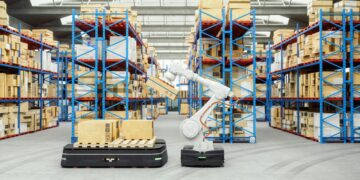
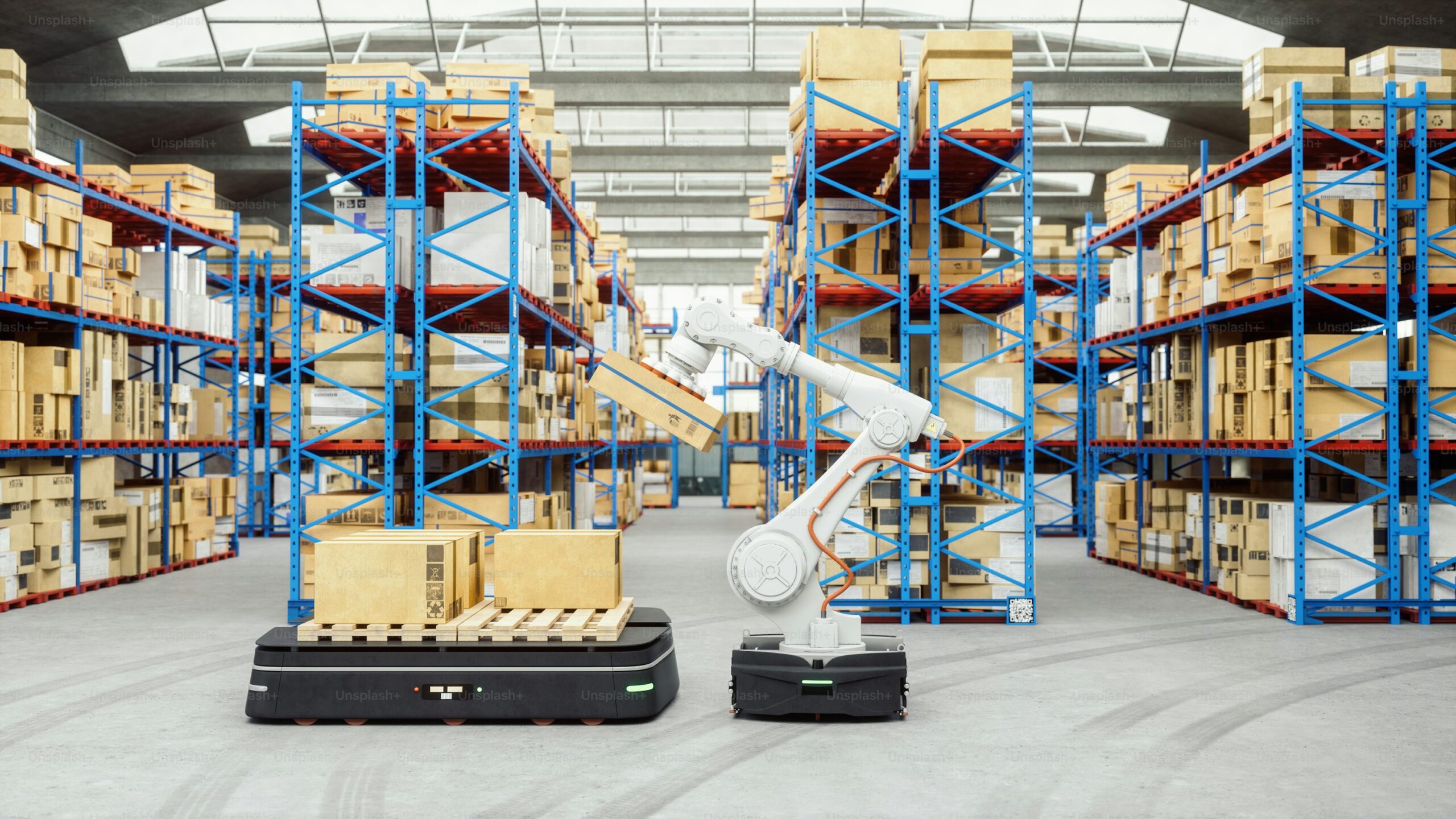
[IMAGE: Modern warehouse with AGV robot and robotic arm automating distribution operations]
Where Can This Technology Be Deployed?
Beyond warehouses, omnidirectional asymmetric robots serve airplane cabins, railway coaches, manufacturing cells, and any confined space requiring material movement (IEEE ICC 2024, 2024). The common thread: environments where turning space is scarce but lateral access is available.
Aircraft cargo loading illustrates the constraint. Traditional pallet jacks need room to turn 90 degrees before entering the cargo hold. An omnidirectional robot rolls sideways directly into position, eliminating the turning maneuver entirely. Railway maintenance crews face similar challenges accessing equipment between tracks.
Manufacturing facilities benefit when production cells pack machines tightly. Material delivery robots slip between equipment without requiring dedicated turning zones at each station. This flexibility enables dynamic rerouting when production schedules change.
The integration layer matters for deployment. Commercial systems offer WMS/MES connectivity out of the box. The Reeman MINI, SEER SOS-1000, and Multiway MW-O series all support standard warehouse protocols (VDA 5050, OPC UA). This means fleet coordination—multiple robots sharing the same space without collisions—becomes a software configuration, not a custom integration project.
Citation Capsule: Omnidirectional asymmetric robots deploy beyond warehouses to airplane cabins, railway coaches, and manufacturing cells where turning space is scarce but lateral access exists, with commercial systems supporting VDA 5050 and OPC UA fleet coordination protocols (IEEE ICC 2024).
[INTERNAL-LINK: robotics implementation roadmap → step-by-step guide for warehouse automation deployment]
What Are the Limitations and Future Improvements?
The IEEE ICC 2024 prototype demonstrates proof of concept, but Variant 2’s even wheel distribution requires caster wheels for stability—a trade-off between width minimization and load-bearing capability (IEEE ICC 2024, 2024). Variant 1 avoids this by placing wheels toward the ends, but this constrains the chassis length-to-width ratio.
Load capacity presents another consideration. The research prototype handles modest payloads with 30 rpm geared motors. Commercial systems scale dramatically higher: SEER SOS-1000 handles 1,000kg, Multiway MW-O series manages 8,000kg. These require larger motors, stronger gearboxes, and reinforced chassis—adding width but maintaining the asymmetric advantage.
Battery life affects continuous operation. The ChipSilicon I10 uses LiFePO4 batteries for 10 hours of runtime, suitable for single-shift operations. Multi-shift facilities need opportunity charging or battery swap systems, adding infrastructure complexity.
Floor conditions matter more for narrow-clearance operations. A 2cm floor bump that conventional AMRs roll over becomes a 10cm+ obstacle when total clearance margins shrink to 10cm. Facility preparation—leveling floors, removing thresholds, sealing cracks—becomes part of the deployment cost.
Citation Capsule: The asymmetric omnidirectional prototype requires caster wheels for stability in Variant 2 configuration, while commercial systems scale to 1,000-8,000kg capacity with larger motors and reinforced chassis, trading some width advantage for payload capability (IEEE ICC 2024).
Frequently Asked Questions
What is the minimum aisle width for omnidirectional AMRs?
In 2026, the Reeman MINI autonomous stacker operates in aisles as narrow as 1.1 meters (3.6 feet) with 500kg capacity, representing the current minimum for commercial omnidirectional AMR systems (Reeman, 2025).
How much does storage density improve with narrow aisle robots?
Warehouse space utilization improves 30-50% with AMR deployment, and high-density robotic storage systems achieve 300-500% storage density increases by eliminating traditional aisle width requirements (OPLOG, 2025).
What is the ROI payback period for narrow aisle AMR systems?
AMR systems achieve ROI payback in 12-18 months according to 2025 warehouse automation studies, compared to 7-12 months for cobot palletizing and 24-30 months for AS/RS systems (SCMR, 2025).
Are mecanum wheel robots suitable for uneven floors?
Mecanum wheels perform best on smooth, level surfaces. Floor irregularities exceeding 5-10mm can cause deviation from commanded trajectory, requiring more frequent PID corrections and potentially reducing battery life due to increased motor load.
How does asymmetric design affect load capacity?
Asymmetric designs maintain load capacity through chassis reinforcement rather than width. Commercial asymmetric omnidirectional forklifts handle 1,000-8,000kg by using larger motors and stronger gearboxes, though this increases width from the 77mm research prototype.
Conclusion
Omnidirectional asymmetric mobile robots represent a fundamental shift in narrow aisle material handling. The IIT Bombay design achieves 77mm width by placing wheels asymmetrically, eliminating the two-motor-width bottleneck of conventional symmetric designs.
The experimental results validate the approach: mean deviations under 6.23cm across all movement modes, with lateral accuracy at 2.28cm—precisely where narrow aisle operations demand the most precision. Commercial systems from SEER, Reeman, and Multiway prove the technology scales from research prototype to 8,000kg industrial payloads.
For warehouse operators facing space constraints, the math is compelling. Moving from 10-foot aisles to 1.1-meter aisles nearly doubles storage capacity without expanding the building footprint. With AMR ROI payback at 12-18 months and 25% CAGR growth through 2030, the economic case strengthens annually.
Key takeaways:
- Asymmetric wheel placement cuts robot width in half (77mm prototype)
- Omnidirectional movement eliminates turning radius requirements
- Commercial systems operate in 1.1-1.75m aisles with 500-8,000kg capacity
- Storage density improves 30-50% with AMRs, 300-500% with high-density systems
- ROI payback: 12-18 months for AMR deployments
[INTERNAL-LINK: warehouse automation ROI calculator → interactive tool for computing payback periods and storage density gains]
Sources
- The Business Research Company, “Autonomous Mobile Robots Global Market Report 2026,” retrieved 2026-05-21, https://www.giiresearch.com/report/tbrc1931878-autonomous-mobile-robots-global-market-report.html
- ABI Research, “50,000 Warehouses to Use Robots by 2025,” retrieved 2026-05-21, https://www.abiresearch.com/press/50000-warehouses-use-robots-2025-barriers-entry-fall-and-ai-innovation-accelerates
- ABI Research, “AMR Warehouse Shipments to Grow at 25% CAGR to 2030,” retrieved 2026-05-21, https://www.abiresearch.com/press/autonomous-mobile-robots-warehouse-shipments-to-grow-at-a-global-cagr-of-25-to-2030-as-solutions-expand-to-new-form-factors
- Emergen Research, “Omnidirectional Autonomous Mobile Robots Market Report,” retrieved 2026-05-21, https://www.emergenresearch.com/industry-report/omnidirectional-autonomous-mobile-robots-market
- Modern Materials Handling, “2026 Outlook Survey,” retrieved 2026-05-21, https://www.mmh.com/article/2026_outlook_survey_signs_of_caution_but_automation_marches_on
- OPLOG, “Warehouse Layout Optimization with Robotics,” retrieved 2026-05-21, https://www.oplog.io/blog/warehouse-layout-optimization-with-robotics
- Exotec, “Complete Guide to Goods-to-Person Automation,” retrieved 2026-05-21, https://www.exotec.com/insights/complete-guide-to-goods-to-person-automation/
- Descartes, “The 2025 Warehouse Performance Benchmark Report,” retrieved 2026-05-21, https://www.descartes.com/sites/default/files/media/documents/2025-11/The-2025-Warehouse-Performance-Benchmark-Report-Final.pdf
- IEEE ICC 2024, “An Omnidirectional Asymmetric Mobile Robot for Narrow Aisle Spaces,” retrieved 2026-05-21, https://controlsociety.org/ICC24/files/0076.pdf
- Reeman, “MINI Autonomous Stacker Forklift: Agile Operation in 1.1m Aisles,” retrieved 2026-05-21, https://www.reemanrobot.com/news/reeman-mini-autonomous-stacker-forklift-agile-85095293.html
- SCMR, “2025 Warehouse Automation Order Fulfillment Study,” retrieved 2026-05-21, https://www.scmr.com/paper/2025-warehouse-automation-order-fulfillment-study
- SEER Robotics, “SOS-1000 Omnidirectional Stack,” retrieved 2026-05-21, https://seer-robotics.ai/amr/autonomousforklifts/SOS-1000
- Multiway Robotics, “MODEX 2026 Showcase,” retrieved 2026-05-21, https://www.mw-r.com/company-news/50